
What is aortic stenosis?
Aortic stenosis is narrowing of the aortic valve that restricts blood flow from the left ventricle to the aorta. In severe aortic stenosis, breathlessness, chest pain, syncope or reduced exercise capacity may occur. Treatment need depends on severity and symptoms; not every stenosis requires the same procedure at the same time.
What is TAVI?
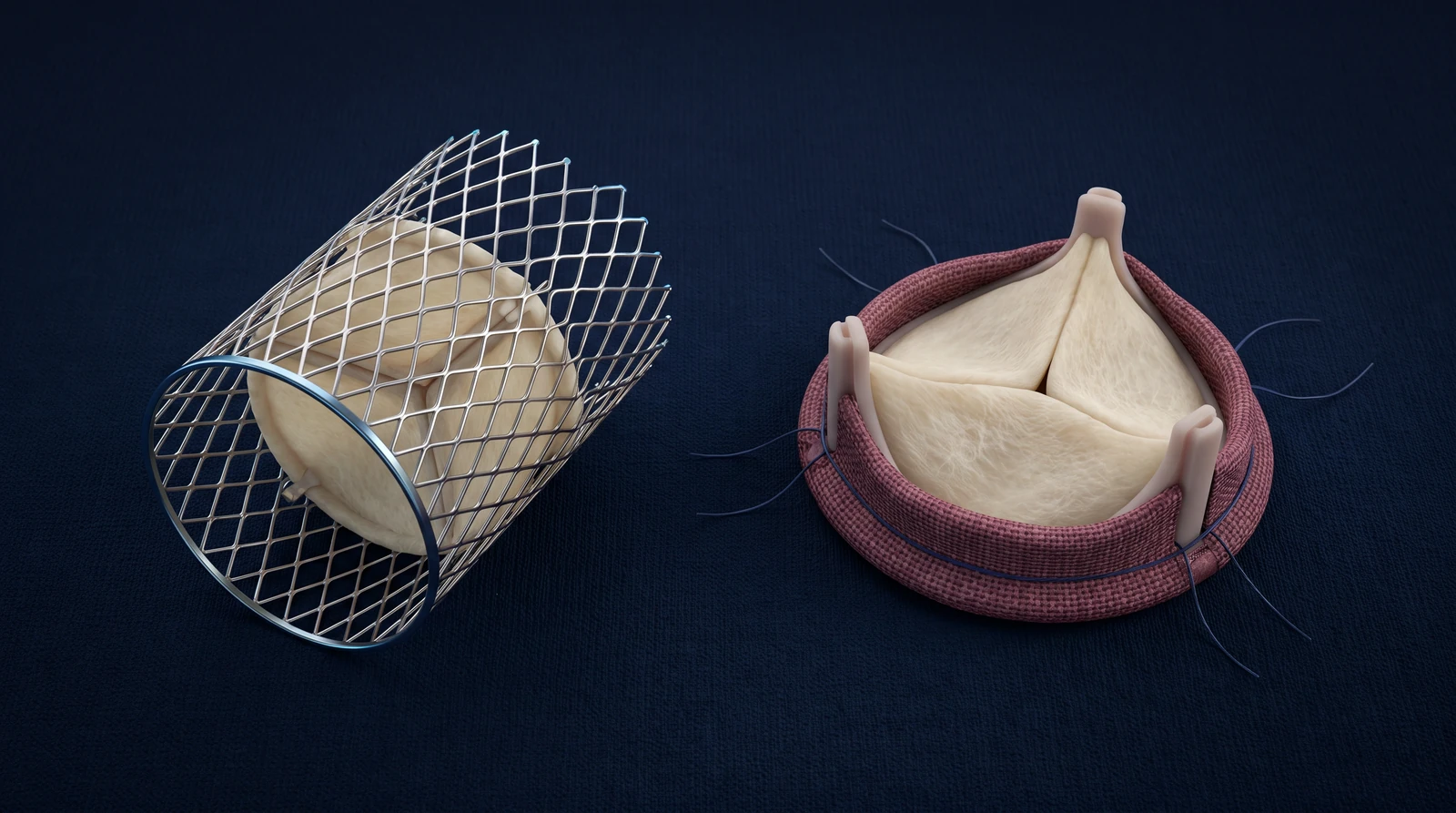
TAVI (Transcatheter Aortic Valve Implantation) places a bioprosthetic valve inside the diseased aortic valve through a catheter. The same approach is also called TAVR (Transcatheter Aortic Valve Replacement); TAVI and TAVR describe the same family of treatment.
Most procedures use femoral-artery (transfemoral) access and do not require sternotomy or classic open-heart surgery. Calling TAVI “surgery-free” is not absolute; it is a catheter-based / minimally invasive intervention and still carries procedural risk. TAVI uses bioprosthetic valves only.
What is surgical aortic valve replacement (SAVR)?
SAVR (Surgical Aortic Valve Replacement) removes the diseased aortic valve surgically and implants a mechanical or bioprosthetic valve. When a mechanical valve is clinically preferred, TAVI is not an alternative to mechanical replacement. Concurrent aortic-root / ascending-aorta surgery or coronary artery bypass grafting (CABG) can be planned in the same sitting when needed.
TAVI or surgery: what do current guidelines say?
The primary European frame for this guide is the 2025 ESC/EACTS Valvular Heart Disease guideline, which replaces the 2021 ESC/EACTS document:
- ≥70 years, tricuspid aortic valve and anatomy suitable for TAVI: TAVI is recommended (Class I, Level A).
- <70 years and low surgical risk: SAVR is recommended (Class I, Level B).
- For other bioprosthetic aortic-valve candidates, TAVI or SAVR is decided by the Heart Team using clinical status, anatomy, procedural risk, life expectancy, lifetime management and patient preference.
Much of the trial advantage for TAVI was shown with transfemoral TAVI; suitability of vascular access is an important part of the decision.
The 2020 ACC/AHA guideline is a complementary US perspective: SAVR if age <65 or expected survival >20 years; shared decision if age 65–80 with symptomatic severe AS and no barrier to transfemoral TAVI; prefer TF-TAVI if age >80 or life expectancy <10 years and TF-TAVI is suitable. European and American age thresholds are not identical; new shared cut-offs should not be invented.
What does the age-70 threshold mean?
The 2025 ESC/EACTS age-70 threshold is read with tricuspid-valve and suitable-anatomy conditions; age alone does not decide. Unsuitable anatomy, bicuspid valve, high coronary-obstruction risk or lifetime-management arguments for SAVR can change the choice independent of age. Likewise, selected higher-risk patients under 70 may still be discussed for TAVI.
When may TAVI be more suitable?
Factors that can influence Heart Team discussion — not an automatic indication list — include:
- ≥70 years + tricuspid aortic valve + suitable anatomy
- Suitable transfemoral vascular access
- Increased surgical risk
- Clinical importance of faster recovery
- Porcelain aorta and other conditions that complicate surgery
- Prior CABG with patent grafts that may make repeat sternotomy more difficult in some patients
Each factor gains or loses weight by patient; none alone proves that “TAVI must be done.”
When may surgery be more suitable?
Situations in which SAVR is more often discussed (still individualised) include:
- <70 years + low surgical risk
- Longer life expectancy / need for lifetime management
- Need for a mechanical valve
- Bicuspid aortic valve, especially in younger patients
- Bicuspid valve with aortopathy
- Need for ascending-aorta / root surgery
- Annulus or vascular anatomy unsuitable for TAVI
- High risk of coronary obstruction with TAVI
- Complex coronary disease needing CABG
- Need for another valve or cardiac operation in the same sitting
Can TAVI be performed for bicuspid aortic valve?
Most patients with bicuspid aortic valve (BAV) were excluded from landmark TAVI–SAVR randomised trials. Bicuspid anatomy can be more complex for TAVI because of asymmetric calcification, elliptical annulus, calcified raphe and coexisting aortopathy.
SAVR remains the mainstay especially in younger patients, those with aortopathy or unfavourable valve anatomy. TAVI may be considered by a Heart Team in selected BAV patients — particularly with higher surgical risk — when anatomy is suitable. It is neither “impossible” nor routinely equivalent to SAVR.
Key differences between TAVI and surgery
Within heart-valve interventions, TAVI and SAVR follow different pathways. The table summarises typical differences without declaring a winner.
| Feature | TAVI | SAVR |
|---|---|---|
| Procedure | Catheter bioprosthetic implantation | Surgical explant and replacement |
| Incision / sternotomy | Usually none (transfemoral) | Usually sternotomy |
| Anaesthesia | Often sedation / selected general anaesthesia | Usually general anaesthesia |
| Hospital stay | Usually shorter | Usually longer |
| Recovery | Usually faster recovery | Longer recovery period |
| Mechanical valve option | No (bioprosthesis only) | Yes (mechanical or bioprosthesis) |
| New pacemaker | More frequent with some systems | Generally less frequent |
| Paravalvular leak | May be more frequent | Less typical |
| Major bleeding | Generally less | May be more frequent |
| New atrial fibrillation | Generally less | May be more frequent |
| Vascular access | Transfemoral suitability is critical | Same vascular prerequisite not required |
| Concomitant CABG | Usually separate / staged | Possible in the same sitting |
| Aortic surgery | Valve-focused; does not treat aortopathy | Can be combined with root / ascending repair |
| Future reintervention | Valve-in-valve / TAV-in-TAV in selected anatomy | Reoperation or valve-in-valve options |
In the 2025 ESC/EACTS frame, vascular complications, paravalvular leak and — especially with some self-expanding systems — new permanent pacemaker are more often seen after TAVI. Major bleeding, acute kidney injury, new atrial fibrillation and longer stay/recovery are more often discussed after SAVR. Absolute claims such as “risk-free,” “easier” or “safer for everyone” are not appropriate.
What did PARTNER 3 show at 7 years?
The PARTNER 3 7-year analysis included 1,000 selected low-surgical-risk patients with severe symptomatic aortic stenosis suitable for TAVI. The composite of death, stroke or valve- / procedure-related heart-failure hospitalisation was 34.6% with TAVR and 37.2% with surgery; the difference was not statistically significant. Death was 19.5% vs 16.8%; stroke 8.5% vs 8.1%; rehospitalisation 20.6% vs 23.5%; bioprosthetic valve failure 6.9% vs 7.5%.
These results do not mean “TAVI is better than surgery” or “the two methods are identical.” The trial enrolled selected low-risk patients with anatomy suitable for TAVI.
What did Evolut Low Risk show at 5 years?
In the Evolut Low Risk 5-year analysis of 1,414 patients (mean age about 74), all-cause mortality or disabling stroke was 15.5% with TAVR and 16.4% with surgery (p=0.47). All-cause mortality was 13.5% vs 14.9%; disabling stroke 3.6% vs 4.0%; valve reintervention 3.3% vs 2.5%. No significant difference was shown for the primary endpoint at 5 years. Findings are interpreted in the context of self-expanding TAVI.
What does NOTION’s 10-year data tell us?
NOTION reported a 10-year death/stroke/MI rate of 65.5% for both TAVI and SAVR in 280 patients (mean age about 79; mostly low surgical risk). Bioprosthetic valve failure was 9.7% with TAVI and 13.8% with SAVR (no significant difference); severe structural valve deterioration was 1.5% vs 10.0%.
The trial is small, includes older patients and earlier-generation prostheses. It should not be read as proof that “a TAVI valve lasts 10 years for sure” or that “lifetime durability in young patients is proven.” Durability is kept limited in this guide; the current 7- and 10-year frame is covered in detail in How long does a TAVI valve last?.
Why does TAVI durability matter especially in younger patients?
When expected survival may outlast prosthesis durability, the first valve choice shapes later options. Short-term trials (for example DEDICATE: death or stroke at 1 year 5.4% with TAVI vs 10.0% with SAVR; TAVI met noninferiority) can look favourable early, but long-term decisions should not rest on one-year data alone. Lifetime management includes CT-based planning, prosthesis–patient mismatch, small annulus and future coronary access.
Can another valve procedure be done after TAVI?
Valve-in-valve or TAV-in-TAV may be considered in selected patients. A second TAVI is not automatically feasible in every anatomy. Coronary obstruction risk, future coronary access, annular size and the first prosthesis type can limit options. TAVI explant surgery can also be technically demanding. The 2025 ESC/EACTS guideline therefore emphasises CT-based lifetime planning, especially when life expectancy may exceed prosthesis durability.
Does coronary artery disease change the decision?
Simple / non-complex coronary disease can be managed with PCI / stenting in some patients; assessment often includes coronary angiography. Complex coronary disease needing CABG may favour SAVR + CABG. TAVI + PCI versus SAVR + CABG should not be reduced to a superficial “which is better” comparison; anatomy and the goal of complete revascularization matter.
What is the Heart Team?
A Heart Team is a multidisciplinary review involving interventional cardiology, cardiac surgery and related clinicians. When both TAVI and SAVR are technically feasible, clinical status, anatomy, procedural risk, life expectancy, lifetime management, local expertise and patient preference are considered together. The aim is not to declare a winner but to choose the path that fits the individual.
In brief: TAVI or SAVR?
For aortic stenosis, the choice between TAVI and surgical aortic valve replacement is not made by age alone. Valve anatomy, surgical risk, transfemoral access, life expectancy, comorbidities and future valve planning are assessed together. The 2025 ESC/EACTS guideline favours TAVI at ≥70 years with suitable anatomy and SAVR at <70 years with low risk; remaining patients are individualised by the Heart Team. Randomised trials report balanced mid- to long-term results in selected cohorts; they do not justify universal superiority or equivalence claims.
Frequently asked questions
There is no single age cut-off. In the 2025 ESC/EACTS guideline, TAVI is recommended for patients aged ≥70 years with a tricuspid aortic valve and suitable anatomy; SAVR is recommended for patients <70 years at low surgical risk. Age is interpreted with anatomy, surgical risk, vascular access and life expectancy.
Yes, in selected patients. When surgical risk is higher and anatomy plus Heart Team review support TAVI, age alone is not a barrier. In younger patients at low surgical risk, SAVR remains the more often preferred option in the European framework.
No. TAVI (transcatheter aortic valve implantation) is usually performed through a catheter via the femoral artery and does not require sternotomy. Calling it “surgery-free” is not absolute; it is a catheter-based / minimally invasive procedure and still carries procedural risks.
These treat different problems. TAVI replaces the aortic valve; bypass (CABG) grafts around coronary stenoses. Some patients need both, in the same sitting or in a staged plan. The decision depends on combined valve and coronary assessment.
After TAVI, vascular complications, paravalvular leak and — with some systems — new permanent pacemaker need may be more frequent. Stroke, bleeding, kidney injury and valve-related issues can also occur. Rates depend on the person, anatomy and plan; TAVI is not risk-free.
Not in every patient. New permanent pacemaker implantation has been reported more often after TAVI than after SAVR, particularly with some self-expanding systems. Conduction anatomy, implant depth and valve type influence risk.
There is no single “how many years” number. In selected low-risk cohorts, PARTNER 3 at 7 years and Evolut Low Risk at 5 years did not show a large difference versus surgery for their primary composites; NOTION’s 10-year data come from a small, older cohort. Durability is especially relevant in patients with longer life expectancy and is discussed within lifetime management.
In selected patients, valve-in-valve or TAV-in-TAV may be considered, but it is not automatically feasible in every anatomy. Coronary access, obstruction risk, annular size and the first valve type can limit later options. Future planning therefore matters at the first decision.
In selected patients — especially with higher surgical risk and suitable anatomy — a Heart Team may consider TAVI. Most landmark TAVI–SAVR trials excluded bicuspid valves; in younger patients, aortopathy or unfavourable anatomy, SAVR remains the mainstay. It is neither “impossible” nor routinely equivalent to SAVR.
There is no fixed number. TAVI is generally linked with a shorter hospital stay and faster recovery; length of stay varies by centre, patient status and complications.
If transfemoral access is unsuitable, alternative access routes or SAVR may be discussed. Much of the trial advantage for TAVI was obtained with transfemoral access; vascular suitability is an important part of the decision.
The decision is shaped by Heart Team assessment. Interventional cardiology, cardiac surgery and related clinicians review clinical status, anatomy, procedural risk, life expectancy, lifetime management and patient preference together.
Literature
References
2025 ESC/EACTS Guidelines for the Management of Valvular Heart Disease. European Heart Journal. 2025. DOI: 10.1093/eurheartj/ehaf194
2020 ACC/AHA Guideline for the Management of Patients With Valvular Heart Disease. Circulation / JACC. DOI: 10.1161/CIR.0000000000000923
Transcatheter or Surgical Aortic-Valve Replacement in Low-Risk Patients at 7 Years (PARTNER 3). N Engl J Med. DOI: 10.1056/NEJMoa2509766
Forrest JK et al. 5-Year Outcomes After Transcatheter or Surgical Aortic Valve Replacement in Low-Risk Patients With Aortic Stenosis (Evolut Low Risk). J Am Coll Cardiol. 2025. DOI: 10.1016/j.jacc.2025.03.004
Thyregod HGH et al. Transcatheter or surgical aortic valve implantation: 10-year outcomes of the NOTION trial. European Heart Journal. 2024. DOI: 10.1093/eurheartj/ehae043 PMID: 38321820.
Blankenberg S et al. Transcatheter or Surgical Treatment of Aortic-Valve Stenosis (DEDICATE). N Engl J Med. 2024;390:1572–1583. DOI: 10.1056/NEJMoa2400685
Continue

