
How long does a TAVI valve last?
There is no single number. Follow-up duration is the horizon over which investigators observed patients; it is not the prosthesis’s true service life. The 2025 ESC/EACTS Valvular Heart Disease guideline advises judging expected survival together with expected prosthesis durability and planning future reinterventions within lifetime management. Patients under 70 are under-represented in randomised TAVI trials; limited very-long-term data contribute to preferring SAVR in low-surgical-risk younger patients. That does not mean “TAVI is never done under 70” or “durability does not matter over 70.”
Does “7-year data” mean the valve lasts 7 years?
No. “A trial followed patients for 7 years” does not mean “the valve lasts only 7 years.” “Ten-year data exist” does not mean “every TAVI valve lasts 10 years.” Real service life may be influenced by patient age, prosthesis type, valve size, haemodynamic performance, structural deterioration, thrombosis/endocarditis and need for reintervention.
What kind of prosthesis is a TAVI valve?
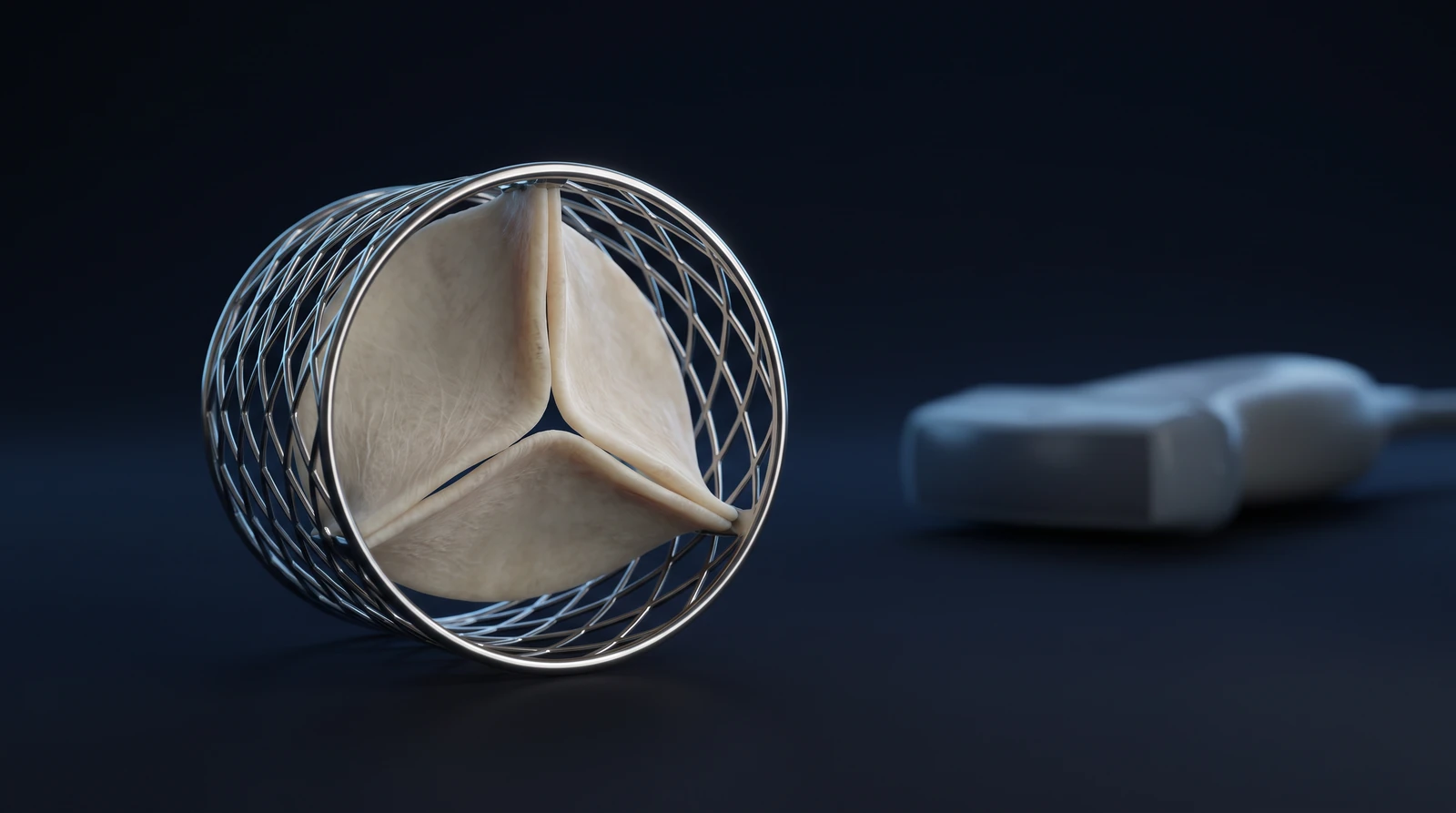
TAVI (transcatheter aortic valve implantation; the same treatment family as TAVR) uses a bioprosthesis with biological leaflets. Over time, leaflet calcification, fibrosis, wear or tear may develop. Not every dysfunction means the valve has simply “aged.” Thrombosis, endocarditis, paravalvular leak and prosthesis–patient mismatch are non-structural causes that must not be confused with SVD. TAVI is not a mechanical valve.
What is structural valve deterioration (SVD)?
Structural valve deterioration (SVD) refers to permanent structural changes in the valve itself. Capodanno and colleagues’ standardisation paper and the later VARC-3 framework aim to report long-term durability in a shared language.
How do BVD, SVD and BVF differ?
In VARC-3, BVD (bioprosthetic valve dysfunction) is the umbrella term and may include SVD, non-structural valve dysfunction, thrombosis and endocarditis. SVD describes structural deterioration. BVF (bioprosthetic valve failure) is a more clinical endpoint and may include advanced dysfunction, valve-related reintervention and/or valve-related death. “Valve deterioration” and “valve failure” are not the same thing.
| Trial | TAVI type | N | Mean age | Follow-up | Key durability finding |
|---|---|---|---|---|---|
| PARTNER 3 | Contemporary balloon-expandable | 1,000 | ~73 | 7 years | BVF 6.9% vs SAVR 7.5% |
| Evolut Low Risk | Self-expanding | 1,414 | ~74 | 5 years | Reintervention 3.3% vs 2.5%; stable haemodynamics |
| NOTION | First-generation self-expanding CoreValve | 280 | ~79 | 10 years | BVF 9.7% vs 13.8%; severe SVD 1.5% vs 10.0%; BVF difference not significant |
Because trials include different devices, eras and populations, rates should not be used for direct device-to-device comparison.
What did PARTNER 3 show at 7 years?
Leon and colleagues’ PARTNER 3 7-year analysis included 1,000 low-surgical-risk patients with severe symptomatic aortic stenosis suitable for transfemoral balloon-expandable TAVR. The composite of death / stroke / valve-procedure-HF related rehospitalisation was 34.6% with TAVR and 37.2% with surgery (no significant difference). Death was 19.5% vs 16.8%; stroke 8.5% vs 8.1%; rehospitalisation 20.6% vs 23.5%; mean aortic valve gradient 13.1 ± 8.5 vs 12.1 ± 6.3 mmHg; BVF 6.9% vs 7.5%.
This must not be turned into “93.1% of TAVI valves last 7 years.” BVF follows defined clinical endpoints; it is not mathematically identical to “the valve is still working.” The main message: in contemporary 7-year balloon-expandable randomised data, bioprosthetic valve failure did not differ substantially between TAVI and surgery. Neither “TAVI is more durable” nor “surgery is more durable” should be claimed.
What did NOTION show at 10 years?
NOTION compared a first-generation self-expanding CoreValve with a surgical bioprosthesis in 280 patients (mean age ~79). At 10 years, death/stroke/MI was 65.5% in both arms. Moderate/severe SVD was 15.4% vs 20.8% (not significant); severe SVD 1.5% vs 10.0%; BVF 9.7% vs 13.8% (not significant); reintervention 4.3% vs 2.2% (not significant).
The trial is small, used a first-generation device, enrolled older patients, and far fewer patients remained alive at year 10 than at baseline. Therefore it is incorrect to say “10-year TAVI durability is proven,” “in young patients TAVI lasts at least 10 years,” or “TAVI is more durable than surgical bioprostheses.” NOTION provides an important favourable randomised 10-year signal — not a standalone definitive answer for modern devices and younger patients.
What do Evolut Low Risk 5-year data show?
In Forrest and colleagues’ Evolut Low Risk 5-year analysis of 1,414 patients (mean age ~74), death or disabling stroke was 15.5% vs 16.4% (p=0.47); all-cause mortality 13.5% vs 14.9%; disabling stroke 3.6% vs 4.0%; valve reintervention 3.3% vs 2.5% (p=0.44); mean valve gradient 10.7 vs 12.8 mmHg. Haemodynamic performance remained favourable with self-expanding TAVR; a lower gradient does not automatically mean longer lifespan. Five-year follow-up is not 15–20-year durability proof; 10-year follow-up is ongoing.
Is a TAVI valve as durable as a surgical bioprosthesis?
Surgical bioprostheses have a longer historical track record than TAVI. Randomised TAVI data at 5, 7 and 10 years are growing. Durability is not a single class effect across all devices and ages; platforms, surgical valves, materials, patient profiles and sizes can differ. No commercial brand comparison is made. Within heart-valve interventions, choice is individualised by the Heart Team.
Why does durability matter more in younger patients?
The same “7-year data” do not mean the same lifetime for a 55–60-year-old and an 80-year-old. In younger patients, expected survival may outlast the first prosthesis. Second valve procedures, valve-in-valve, TAV-in-TAV, surgical explant and coronary access should therefore be considered at the first procedure. A categorical “TAVI is not done in the young” message is not used.
If a TAVI valve deteriorates, can TAVI be repeated?
In selected suitable patients, a new transcatheter valve may be placed inside the existing bioprosthesis. That is not an automatic solution in every anatomy.
What are valve-in-valve and TAV-in-TAV?
TAV-in-TAV places a new TAVI inside a prior transcatheter valve. Valve-in-valve / TAV-in-SAV places a transcatheter valve inside a prior surgical bioprosthesis. Suitability depends on prior prosthesis size, sinus anatomy, coronary ostia, neo-skirt height, coronary-obstruction risk, residual gradient, patient–prosthesis mismatch and future coronary access. Redo surgery may be preferable in some patients. The simplification “when it fails, another valve is put inside and the problem is solved” is incorrect.
Can open surgery be done later after TAVI?
Surgical explant of a TAVI prosthesis is possible; it is not the same as redo TAVI and can be technically complex. The 2025 ESC/EACTS guideline advises considering future TAVI explant and reintervention risks when choosing the first valve. Early mortality percentages are not presented sensationally here; the key message is that future options should be planned before the first procedure.
How is valve durability followed?
Echocardiography is central: gradients, opening, transvalvular regurgitation, paravalvular leak, left-ventricular function and symptoms. The EAPCI/ESC/EACTS durability consensus outlines baseline post-procedure, 1-year and then regular/annual echo surveillance scientifically. Individual interval depends on clinical status and clinician judgement; this guide does not prescribe “mandatory yearly echo for every patient.”
Which symptoms should prompt valve reassessment?
New or worsening breathlessness, reduced exercise capacity, chest pain, syncope/near-syncope or heart-failure signs may warrant reassessment of valve function. These symptoms are not specific to valve deterioration alone.
What factors may influence TAVI valve lifespan?
Factors that may be discussed include patient age, prosthesis type/generation, valve size, baseline haemodynamics, patient–prosthesis mismatch, kidney disease and mineral metabolism, thrombosis and endocarditis. Observational associations should not be presented as proven individual “shortens life by X years” claims.
In brief: how much do we know today?
There is no fixed TAVI “lifespan year.” Contemporary balloon-expandable randomised data reach 7 years; older self-expanding randomised data in NOTION reach 10 years. Those horizons are reassuring for mid- to long-term durability; definitive 15–20-year proof — especially in younger patients — is not complete. BVF percentages must not become marketing statistics; follow-up duration must be separated from prosthesis service life. Lifetime management, the Heart Team and individual anatomy remain central.
Frequently asked questions
There is no fixed lifespan for every patient. Randomised follow-up reaches 7 years for contemporary balloon-expandable TAVI and 10 years for older self-expanding TAVI in NOTION. Those horizons do not mean the valve “lasts only 7 or 10 years,” and 15–20-year durability is not definitively proven, especially in younger patients.
No. Ten-year data means one trial (NOTION) followed patients for 10 years; it does not mean every TAVI valve lasts 10 years. NOTION was small, older and used a first-generation device.
No. The 7-year BVF rate in PARTNER 3 does not mean every valve is replaced at 7 years. Most patients are followed clinically and by imaging; reintervention is considered only when findings warrant it.
New or worsening breathlessness, reduced exercise capacity, chest pain, near-syncope/syncope or heart-failure signs may prompt reassessment of valve function. These symptoms are not specific to valve failure; echocardiography and clinical review are needed.
Options depend on clinical status, anatomy and the first prosthesis. Some patients may be candidates for TAV-in-TAV or valve-in-valve; others may need surgical explant / redo surgery. There is no automatic “put another valve inside and it is solved” path.
In selected suitable anatomies, redo TAVI / TAV-in-TAV may be considered. Suitability depends on prior prosthesis size, sinus anatomy, coronary ostia, coronary-obstruction risk, residual gradient and future coronary access.
In some patients yes (TAV-in-TAV). It is not feasible in every anatomy; a Heart Team assesses anatomy and risks. Placing a transcatheter valve inside a surgical bioprosthesis (valve-in-valve / TAV-in-SAV) is a different scenario.
Yes — TAVI explant and surgical replacement are possible in some patients, but can be technically complex and are not the same as redo TAVI. The 2025 ESC/EACTS guideline advises considering future explant / reintervention when choosing the first valve.
Expected survival may outlast prosthesis durability. Patients under 70 are under-represented in randomised TAVI trials; limited very-long-term data are part of lifetime-management discussion. That does not mean “TAVI is never done under 70.”
There is no single class effect. In PARTNER 3 at 7 years, BVF was 6.9% with TAVI vs 7.5% with SAVR; in NOTION at 10 years, BVF was 9.7% vs 13.8% (no significant difference). Surgical bioprostheses have a longer historical track record; device, patient and size matter. No brand or method superiority is claimed.
No. TAVI uses a bioprosthetic (biological leaflet) valve. Mechanical valves are not offered via TAVI; when a mechanical valve is needed, surgical assessment applies.
Bioprosthetic leaflets can develop calcification, fibrosis or wear; that may be part of SVD. Not every dysfunction is “calcification”; thrombosis, endocarditis or paravalvular leak are other non-structural causes.
Echocardiography is the main tool: gradients, opening, regurgitation, paravalvular leak, left-ventricular function and symptoms are assessed together. Consensus documents outline regular surveillance; individual interval depends on clinical status.
In 1,000 selected low-risk patients suitable for TAVI, the primary composite and BVF did not differ substantially between TAVI and surgery at 7 years. That must not be turned into a marketing statistic such as “93.1% of TAVI valves last 7 years.”
In a small, older cohort with first-generation self-expanding TAVI, 10-year randomised follow-up showed no significant BVF difference versus SAVR. It is an important favourable long-term signal — not a definitive answer for modern devices and younger patients alone.
Literature
References
Praz F et al. 2025 ESC/EACTS Guidelines for the management of valvular heart disease. European Heart Journal. 2025;46:4635–4736. DOI: 10.1093/eurheartj/ehaf194
Leon MB et al. Transcatheter or Surgical Aortic-Valve Replacement in Low-Risk Patients at 7 Years. N Engl J Med. 2026;394:773–783. DOI: 10.1056/NEJMoa2509766 PMID: 41144631.
Thyregod HGH et al. Transcatheter or surgical aortic valve implantation: 10-year outcomes of the NOTION trial. European Heart Journal. 2024;45:1116–1124. DOI: 10.1093/eurheartj/ehae043 PMID: 38321820.
Forrest JK et al. 5-Year Outcomes After Transcatheter or Surgical Aortic Valve Replacement in Low-Risk Patients With Aortic Stenosis. J Am Coll Cardiol. 2025;85:1523–1532. DOI: 10.1016/j.jacc.2025.03.004
Généreux P et al. Valve Academic Research Consortium 3: Updated Endpoint Definitions for Aortic Valve Clinical Research. European Heart Journal. 2021;42:1825–1857. DOI: 10.1093/eurheartj/ehab175
Capodanno D et al. Standardized definitions of structural deterioration and valve failure in assessing long-term durability of transcatheter and surgical aortic bioprosthetic valves. European Heart Journal. 2017;38:3382–3390. DOI: 10.1093/eurheartj/ehx303
Continue

